

Historically, the application of Marxism and associated heterodoxic strains as primacy in nation-states (and the unions they form) have been authoritarian or totalitarian in practice as is the metaphysical worldview of State Atheism that Karl Marx intertwined into his theory. State Atheism briefly occurred during the French Revolution before fading and then resurging in the world under Marxist Communism (Marx, 1997; McGrath, 2006).
A Dictionary of Atheism (Bullivant and Lee, 2016) defined State Atheism as follows, “State Atheism is the name given to the incorporation of positive (i.e., strong) atheism or non-theism into political regimes” (p. 74).
Review the 1929 cover of the Soviet magazine Bezbozhnik (Bezbozhnik, 2022) displaying the first five-year plan of the atheist state to crush Judaism, Christianity, and Islam.
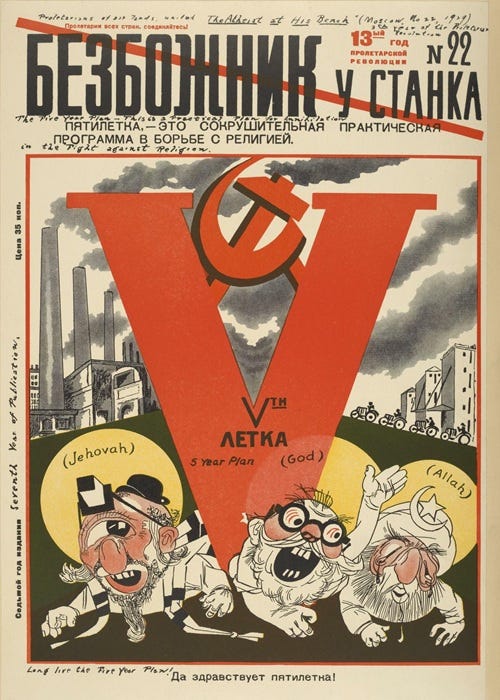
State Atheism was first attempted on a large-scale by Marxists in the Soviet Union and most of eastern Europe. As Stark (2007) explained, “Almost immediately after they seized power in Russia in 1917, the communists embarked on a massive campaign to stamp out all traces of all religions… The communist regimes imposed by the Russian army on most of eastern Europe at the end of World War II also instituted efforts to eliminate religion. Although enforcement efforts generally were less vigorous and brutal than those initiated in Russia following the revolution, they were as fully intended to wipe out religion” (pp. 404-405).
Atheism was systemically forced into the educational curriculum, official discrimination and persecution was implemented against those suspected of being religious, almost all religious centers were closed with many destroyed or converted to non-religious uses though some were left open under strict state control with their leadership subverted by secret police agencies. This was useful to the Marxist communists in their propaganda efforts with the West and to aid their anti-religious secret police operations on the populace (Stark, 2007; Adelman & Bacon, 2019).
Stark (2007) wrote, "If one wanted to get ahead, one either professed atheism and stayed away from churches or kept one's religious propensities a secret. Never before in human history has there been such a concerted effort to stamp out not merely a religion but all trace of religion. Atheistic Communism thought of itself as pushing forward the inevitable process of secularization in which religion would disappear from the face of the earth" (pp. 404-405).
In Matthew 6:24, Jesus Christ asserted that "No one can serve two masters." The context speaks to the idolization of wealth accumulation; however, the diversity of conflicting interests regarding the “two masters” gives the point a metaphorical dimension for this discussion as wherever Marxism has been implemented as a dominant form of government, it is always accompanied by discrimination against and persecution of religious people (NASB, 1997).
This even includes Christians today being increasingly targeted in Western nations influenced by socialism for engaging in religious speech acknowledging God’s holiness within traditional orthodox biblical standards when done in public or online. Social pressure and the governmental censorship targeting of Christians in Europe is intensifying and Christians should take note of this (OIDAC, 2022).
Marx mistakenly painted all religion as negative ignoring the great advances made by Christians operating from the Christian worldview. For example, the intellectual climate that gave rise to modern science, the principles underlying the scientific method (e.g. testability, verification/falsification), etc. were decisively shaped by Christians operating within the Christian worldview while competing non-Christian civilizations often suffered material stagnation, in comparison, due to impediments associated with their worldviews (Hannam, 2011; Samples, 2007; Stark, 2004, 2015).
Marx viewed religion, rather than unregenerate human nature operating in an environment of economic scarcity, as driving inequity (Sociological Approach to Religion, 2021). He saw religion as a competitive threat to the adoption and propagation of his theory that he desired to subjugate humanity’s hearts and minds to, apart from the Judeo-Christian creator God or any other worldview (Stark, 2007).
The predictable result has been the permanent Marxist effort to subjugate and destroy religion which naturally encompasses targeting religious people. As stated, this behavior is systemic to Marxism and so the forever-persecution and forever-attempt to subjugate religion for elimination continues including where freedom-of-religion verbiage is written into communist constitutions as seen in communist China. (Adelman & Bacon, 2019; Pew Research Center, 2023).
As Stark (2007) noted this is because State Atheism and all metaphysical worldviews active in the world are in competition. The resulting conflict is inherent. He refers to this in terms of a religious economy but it is best put for this discussion as a metaphysical worldview economy.
Nee (2021) explained how the People’s Republic of China (PRC) provides a 21st century example of a Marxist government that censures and persecutes religious people under their control while simultaneously working to corrupt religious doctrine to subjugate it to the Chinese atheist state.
Regarding the strict centralization of power, China is a nation of over 1.4 billion people that is ruled by an authoritarian plutocracy of 25 very wealthy elitists comprising the Politburo of the Chinese Communist Party which is headed by a Politburo Standing Committee of just seven individuals from among them (Politburo of the Chinese Communist Party, 2022). Xi Jinping rose to the top of the seven in practice “as the ultimate arbiter of its specific values, morals, ethics, and societal goals” (Nee, 2021, para. 32). Xi Jinping echoed Zhou Enali’s “We Communists are atheists” (Noebel, 2001).
Scholars are still debating the actual number that died because of State Atheism as liberal academics want to exclude the Marxist state-sponsored famines, forced deportations, and hard labor political prison deaths but it is clear that a large number of people perished under these government’s religious purges while many more were persecuted. Their stories are deeply personal (Rummel, 1994).
For example, it was not uncommon for religious people to be arrested by communist secret police, badly beaten, relieved of their property, and led off to hard labor camps (or state mental institutions) where some were never heard from again. Their children were placed in state run orphanages where they also experienced persecution for being the progeny of religious parents when no relatives willing to take them in could be found.
Such stories and accompanying documentation are stored in microfilm collections like the Archives of the Soviet Communist Party and Soviet State and the Boris Nicolaevsky Collection, both of which are located at the Hoover Institute.
As the late Romanian pastor Richard Wurmbrand (1967) observed:
"The cruelty of atheism is hard to believe. When man has no faith in the reward of good or the punishment of evil. There is no reason to be human. There is no restraint from the depths of evil which is in man. The torturers often said, ‘There is no God, no Hereafter, no punishment for evil. We can do what we wish.’ I have heard one torturer even say, ‘I thank God, in whom I don’t believe, that I have lived to this hour when I can express all the evil in my heart.’ He expressed it in unbelievable brutality and torture inflicted on prisoners” (p. 34).
Those professing to be Christian may fail to live up to Christ's teaching, to whatever degree they do in this world, while those atheists who claim to hold to secular humanism may fail to live up to its tenants but it is the Christian worldview that posits an ultimately meaningful accountability. A worldview which asserts a relationship between nature and a loving yet holy transcendent creator God at work for good, but against evil which is to ultimately suffer defeat.
And though invading Muslims are reputed to have killed tens of millions during the centuries-long Islamic expansionary period in places like Hindu dominated India (Bostom & Warraq, 2010), what was then a Christianized North Africa (Speel II, 1960), etc., conservative scholars argue that the number killed by their own governments (democide) under Marxism in a single century materially exceeds this (Rummel & Horowitz, 1994).
In comparison, most scholars estimate the total number of deaths in all the crusades on both sides at between one million and nine million with the likely number somewhere in the middle (Rist, 2020, para. 20; Stark, 2010).
And as an aside, while the long history of infectious diseases causing sweeping epidemics around the world are intertwined with the movement of humanity; it varies with most of the Old-World diseases originating in Africa and Asia and being carried to Europe before the period of European colonization began (Magner, 2009).
When communist regimes collapse, polling shows a rapid resurgence of religion in these areas. Stark (2007) wrote, "With the recent breakup of the Soviet Union and the collapse of communist regimes in eastern Europe, religious repression subsided" and that "Atheists are few in eastern Europe and Russia, and large numbers identify themselves as religious. This is not what surveys would have found when the communists were still in power, for then many people were (rightfully) too suspicious of survey interviewers to tell them the truth" (p. 405).
Stark (2007) cited Sergei Borisovich Filatov and Dmitrii Efimovich Furman's 1993 research showing "an abrupt growth in religiosity and the disappearance, equally abrupt, of atheism" (p. 405).
They used old Soviet surveys and newer post-Soviet surveys in large Russian cities revealing that in 1990 only 24 percent still said they were atheists and only two years later in 1992 only 8 percent were still atheists. Stark noted that it is plausible "that a similar rapid drop in the percent of atheists would take place in China if the government were to permit religious freedom" and that “massive religious revivals currently are under way in the nations of the former Soviet Union and in the former Soviet-controlled nations of eastern Europe as well” (Stark, 2007, p. 405).
Despite a decrease in organized attendance documented in the West (Davis et al., 2023), globally it appears that most people like religion (Pew Research Center, 2015). They look to “systems of thought that include belief in the supernatural” when addressing problems of magnitude that might benefit from transcendence (Stark, 2007, p. 406).
Conservative scholars also note that while colonialism and Christianity may each start with the letter "c," in the English language, they are not the same thing. They remind us that every major worldview has had adherents represented in colonizing (i.e. the sending of people to live in and govern others in a particular area) and that includes Marxism (with its atheist view of the world).
Societies should legislate a right economic equity for their vulnerable citizens (e.g. orphans, the disabled, the sick, the elderly); assist the poor (see the Epistle of James); and allow debt forgiveness for those who become impoverished. But, societies should do so without ever invoking the tyranny and state atheism inherent in Marxism. In fact, not providing a reasonable economic equity for such invites the problem.
One much needed place to begin is to remove the economic incentives that politicians presently enjoy to destabilize the domestic labor market for the citizens of whichever nation they are elected to represent. Political representatives currently benefit from corporatist and globalist interests seeking to lower labor costs to increase their wealth as rapidly as possible in a non-symbiotic manner.
They facilitate the mass offshoring of the nation’s jobs they are elected to preserve; the mass outsourcing of domestic work to foreign firms; the mass in-sourcing of foreign replacement labor; a rapid acceleration of automation; and unfair trade agreements all of which destabilize the domestic labor markets for the nation’s citizens they are elected to represent. This results in high “functional unemployment;” high non-entitlement social service costs; increasing income inequality; escalating government debt; lower real-wages; etc.
And such reform should be accompanied by correctly strengthening election integrity to avoid the serious problems evidenced in recent federal elections.
Bibliography
Adelman, J. R., & Bacon, W. (2019). Terror and communist politics. Routledge.
Bezbozhnik (Soviet newspaper). (2022, October 21). In Wikipedia. https://en.wikipedia.org/w/index.php?title=Bezbozhnik_(newspaper)&direction=prev&oldid=1121234232
Bostom, A. G., & Warraq, I. (2010). The legacy of Jihad: Islamic holy war and the fate of non-Muslims. Prometheus Books.
Bourguina, A. & Jakobson, M. (1989). Guide to the Boris I. Nicolaevsky collection. Hoover Institution Press.
Bullivant, S., & Lee, L. (2016). A dictionary of atheism. Oxford University Press.
Courtois, S., & Kramer, M. (2004). The black book of Communism: Crimes, terror, repression. Harvard University Press.
Cult of Reason. (2023, November 20). In Wikipedia. https://en.wikipedia.org/w/index.php?title=Cult_of_Reason&direction=prev&oldid=1191440496
Davis, J., Margaret Bloy Graham, & Burge, R. P. (2023). The Great Dechurching. Zondervan.
Finke, R., & Stark, R. (2006). The churching of America, 1776-1990: Winners and losers in our religious economy. Rutgers Univ. Press.
Greeley, A. (1994). A religious revival in Russia? Journal for the Scientific Study of Religion, 33(3), 253. https://doi.org/10.2307/1386689
Hannam, J. (2011). The genesis of science: How the Christian Middle Ages launched the scientific revolution. Regnery. Hoover Institution. (n.d.). Archives of the Soviet Communist Party and Soviet State Microfilm Collection. https://www.hoover.org/library-archives/collections/archives-soviet-communist-party-and-soviet-state-microfilm-collection Kengor, P., & Knowles, M. (2020). The devil and Karl Marx: Communism's long march of death, deception, and infiltration. Tan Books.
LISEP Ludwig Institute for Shared Economic Prosperity. (n.d.). https://www.lisep.org
Madden, T. F. (2014). The concise history of the crusades. Rowman & Littlefield.
Magner, L. N. (2009) A history of infectious diseases and the microbial world. Praeger.
Marx, K. (1848). The communist manifesto. Workers’ Educational Association.
Marx, K. (1997). Class struggles in France, (1848-1850). International Publishers. (Original work published 1850).
Mass killings under communist regimes. (2022, October 30). In Wikipedia. https://en.wikipedia.org/w/index.php?title=Mass_killings_under_communist_regimes&oldid=1119058164
Mcgrath, A. E. (2006). The twilight of atheism: The rise and fall of disbelief in the modern world. Doubleday.
Mitchell, J. (2024). Episode 8: The Imago and politics [online course]. In Zorzi, G., James, S., Richards, J., Thompson, K., Luskin, C., Mitchell, M., McKinley,
M., Mitchell, J., The Imago Dei. Patrick Henry College. https://courses.phc.edu/courses/take/the-imago-dei/lessons/54955053-8-the-imago-and-politics
Nee, W. (2021, August 17). In China, 'xi jinping thought' is the only accepted religion. The Diplomat. https://thediplomat.com/2021/08/in-china-xi-jinping-thought-is-the-only-accepted-religion/
New American Standard Bible. (1997). (Original work published 1960). The Lockman Foundation
Noebel, D. (2001). The battle for truth: defending the Christian worldview in the marketplace of ideas. Harvest House Publishers.
Observatory on Intolerance and Discrimination against Christians (OIDAC). (2022). OIDAC Europe Annual Report 2021 (P. Chavez, M. Enzlberger, & M. Kugler, Eds.) OIDAC Europe. https://www.intoleranceagainstchristians.eu/fileadmin/user_upload/publications/files/Annual_Report_2022_-_ONLINE_Web_View_Final.pdf
Pew Research Center. (2023). Measuring religion in China. https://www.pewresearch.org/wp-content/uploads/sites/20/2023/08/PF_2023.08.30_religion-china_REPORT.pdf
Pew Research Center. (2015). The future of world religions: population growth projections, 2010-2050. https://www.pewresearch.org/religion/2015/04/02/religious-projections-2010-2050/
Politburo of the Chinese Communist Party. (2022, October 31). In Wikipedia. https://en.wikipedia.org/w/index.php?title=Politburo_of_the_Chinese_Communist_Party&oldid=1119291723
Rist, R. (2020, June 1). Your top questions about the crusades – answered. https://www.historyextra.com/period/medieval/crusades-causes-history-when-how-many-were-there-death-toll/ The official website for BBC History Magazine and BBC History Revealed
Rummel, R.J., & Horowitz, I.L. (1994). Death by government: Genocide and mass murder since 1900 (1st ed.). Routledge.
Rummel, R. J. (2002, November 23). Freedom, democracy, peace; power, democide, and war. https://www.hawaii.edu/powerkills/LINKS.HTM#COMMUNISM | Links to material on democracy, democide, and war
Rummel, R. J. (2017). China's bloody century: Genocide and mass murder Since 1900. Routledge.
Samples, K. R. (2007). A world of difference: Putting Christian truth-claims to the worldview test. Baker Books.
Sociological Approach to Religion. (2021, February 19). https://socialsci.libretexts.org/@go/page/1087
Speel II, C. J. (1960). The Disappearance of Christianity from North Africa in the Wake of the Rise of Islam. Cambridge University Press, 29(4), 379–397. https://doi.org/10.2307/3161925
Stark, R. (2004). For the glory of God: How monotheism led to reformations, science, witch-hunts, and the end of slavery. Princeton Univ. Press.
Stark, R. (2007). Sociology (7th ed.). Wadsworth.
Stark, R. (2010). God's battalions: The case for the Crusades. Harper One.
Stark, R. (2015). How the West won: The neglected story of the triumph of modernity. ISI Books.
Solzhenitsyn, A. I. (2007). The gulag archipelago: An experiment in literary investigation, complete 3 volumes collection (volume 1, 2, 3). Harvill Press.
State Atheism. (2024, May 28). In Wikipedia. https://en.wikipedia.org/w/index.php?title=State_atheism&direction=prev&oldid=1226134186
Tortured for Christ - Richard Wurmbrand. (2019, December 04). https://www.brighteon.com/40ebfdd0-ae3e-4a8b-bf0b-43bb11e0ccb0
Welfare Budget. (n.d.). Federal Safety Net. https://federalsafetynet.com/welfare-budget/
Wurmbrand, R. (1967, February 28). Tortured for Christ. Independently published.
Fair Use: Copyright Disclaimer Under Section 107 of the Copyright Act in 1976; Allowance is made for "Fair Use" for purposes such as criticism, comment, news reporting, teaching, scholarship, and research. Fair use is a use permitted by copyright statue that might otherwise be infringing. All rights and credit go directly to its rightful owners. No copyright infringement intended.
Notice: Content on this page (including reviews, business, theology, and technology commentary) is provided for informational and opinion purposes only and does not constitute professional, legal, financial, medical, or pastoral advice. Reviews may include quotations or summaries under fair use. All views expressed are those of the author alone. While every effort is made to ensure accuracy, no warranties are provided. Use and rely on this content at your own risk. For important decisions, consult qualified professionals. For copyright takedown requests or corrections, please email ppothier@substack.com with the subject “Takedown/Correction” and include full details. Effective: 2026-05-08.
Copyright © 2024 Paul L. Pothier. All rights reserved.